

Software Quality Engineering für Developer: Der Method Stack für bessere Software
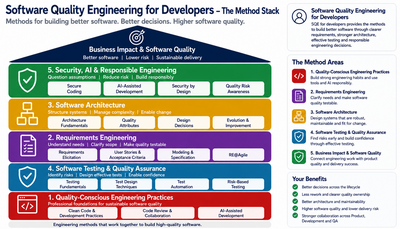
Software Quality Engineering für Developer ergänzt den technischen Tech Stack um die Methoden, mit denen Softwareentwickler Anforderungen hinterfragen, Architekturentscheidungen bewerten, wirksame Tests entwerfen und Sicherheitsrisiken früh erkennen können. Gerade bei AI-assisted Coding entscheidet nicht mehr allein die Geschwindigkeit der Codeerzeugung über den Erfolg, sondern die Fähigkeit, Ergebnisse fachlich und technisch zu beurteilen.
Passende Weiterbildung finden: Alle Seminare für Entwickler ansehen
Why Software Quality Engineering for Developers Is Becoming Essential
Programming languages, frameworks, databases and development tools determine how a solution can be implemented. They do not automatically determine whether the right solution is being built.
An AI coding assistant can generate code and unit tests within seconds. Important questions may nevertheless remain unanswered:
- Has the underlying business rule been understood correctly?
- Does the proposed solution fit the existing software architecture?
- Are relevant boundary conditions and exceptional cases covered?
- Does a new dependency create a security or maintainability risk?
- Will the solution remain viable when requirements and systems change?
- Does the implementation solve the real user or business problem?
These decisions remain the responsibility of the people who review, integrate and maintain the code. Developers therefore need a Method Stack alongside their Tech Stack.
The Method Stack for Modern Software Development
A Method Stack does not require every developer to become a fully qualified Requirements Engineer, Software Architect, Test Manager and Security Specialist.
Instead, it provides sufficient method competence to recognise critical assumptions, ask better questions, evaluate proposed solutions and involve specialists at the right time.
Requirements Engineering for Developers: Replace Hidden Assumptions with Clear Requirements
Unclear requirements do not become more precise through AI-assisted coding. A short prompt or incomplete backlog item simply encourages the model to fill information gaps with assumptions.
Requirements Engineering helps developers to:
- identify ambiguous terms and business rules,
- recognise missing stakeholders and exceptional cases,
- clarify functional and quality requirements,
- assess whether user stories and acceptance criteria are testable,
- formulate better tasks and prompts for AI assistants,
- distinguish the actual problem from a proposed implementation.
An IREB training course is therefore not relevant only to Requirements Engineers or Business Analysts. Developers also benefit from a structured understanding of how requirements are elicited, documented, validated and managed.
Learn More about Requirements Engineering for Developers
Software Architecture for Developers: Evaluate Local Changes in the Wider System
AI assistants usually operate within a limited context. A proposed change may work locally while violating existing architecture principles, dependency rules or system-wide quality requirements.
Software Architecture competence helps developers answer questions such as:
- Which component should own a particular responsibility?
- What new coupling will the proposed solution create?
- Which quality attributes will be affected?
- What follow-up changes are likely?
- Does another service or component already fulfil the same responsibility?
- How will the decision affect maintainability, performance, security or scalability?
An iSAQB training course is particularly relevant for senior developers and technical leads who want to understand, document and justify architecture decisions and gradually assume greater responsibility for the overall system.
Learn More about Software Architecture for Developers
Software Testing for Developers: Better Test Ideas, Not Only More Coverage
AI can generate test code rapidly. The central question is not how many tests exist, but whether they address the relevant risks.
Software Testing provides techniques that help developers select effective test cases:
- equivalence partitioning for different input groups,
- boundary value analysis for critical value ranges,
- decision tables for complex business rules,
- state models for behaviour that depends on previous actions,
- risk-based testing for prioritising the most important checks,
- exploratory testing for risks that cannot be fully anticipated.
An ISTQB training course can therefore also be valuable for developers. It is particularly relevant for professionals who design automated checks, perform code reviews or share responsibility for product quality in cross-functional teams.
Learn More about Software Testing for Developers
Secure Coding for Developers: Identify Security Risks during Implementation
Insecure software often performs its intended function correctly. The problem becomes visible only when inputs are manipulated, authorisation controls are bypassed, sensitive information is logged or vulnerable dependencies are exploited.
Secure Engineering and Secure Coding training helps developers to:
- validate inputs and interfaces systematically,
- implement authentication and authorisation correctly,
- design secure error handling and logging,
- assess the risks of third-party components,
- protect secrets and sensitive information,
- integrate security requirements into architecture and code.
Security should not begin with a final audit or penetration test. Many vulnerabilities can be avoided while requirements, architecture and code are still being developed.
Learn More about Secure Engineering
Which Software Quality Engineering Training Fits Your Developer Role?
Software Quality Engineering for Junior Developers
Junior developers initially benefit from fundamental test techniques, clear requirements and maintainable development practices.
Suitable starting topics include:
- ISTQB Certified Tester Foundation Level,
- Requirements Engineering fundamentals,
- Clean Code and development practices,
- Secure Development Principles,
- basic software modelling and documentation.
The objective is not to add unnecessary theory, but to provide methods that help developers understand why an implementation is correct.
Software Quality Engineering for Experienced Developers
Experienced developers benefit particularly from deeper Requirements Engineering, systematic test design, Software Architecture and Secure Coding.
Course selection should begin with recurring problems from daily work:
- misunderstood business rules,
- fragile components,
- difficult integration decisions,
- insufficient test coverage,
- repeated production defects,
- unclear responsibility between teams.
The most effective learning path addresses these concrete problems instead of collecting unrelated certificates.
Software Quality Engineering for Senior Developers and Technical Leads
As responsibility grows, architecture decisions, quality attributes, technical debt, security and the communication of trade-offs become increasingly important.
Relevant learning paths may include:
- iSAQB CPSA Foundation Level,
- advanced Software Architecture modules,
- architecture improvement and evolutionary design,
- Domain-Driven Design,
- technical leadership and communication,
- Secure Engineering and threat modelling.
Senior professionals need methods that help them make decisions understandable and defensible across system and organisational boundaries.
Software Quality Engineering for AI-Assisted Development
Developers who work intensively with coding assistants need more than prompting skills.
Requirements Engineering improves the quality of the task definition. Testing methods improve the evaluation of generated results. Architecture and security knowledge help developers assess whether a locally plausible suggestion is suitable for the wider system.
The more implementation becomes automated, the more important professional judgement becomes.
Software Quality Engineering Training for Development Teams
In scaling software organisations, quality problems rarely belong to one role alone.
Unclear requirements, architecture debt, weak testing and security risks reinforce one another. A defect that appears to be a testing problem may originate in an ambiguous requirement. A maintenance problem may be the result of an undocumented architecture decision. A security weakness may stem from both missing requirements and unsafe implementation.
A shared Software Quality Engineering programme can help development teams to:
- establish a common language for software quality,
- reduce misunderstandings between product, development and QA,
- identify quality risks earlier,
- make architecture and testing decisions transparent,
- improve collaboration across specialist roles,
- use AI-assisted coding in a controlled and professional way.
Public courses are suitable for individual developers and personal career paths. In-house training enables organisations to develop several team members together and align the methods with internal roles, systems and quality problems.
Software Quality Engineering Methods Do Not Have to Be Bureaucratic
Method-based development does not mean producing extensive documentation for every decision.
An Architecture Decision Record can consist of a few clear sections. A quality requirement can be expressed in one precise and measurable sentence. An initial threat analysis can begin with a system sketch and a focused set of questions.
The value of a method is not determined by the amount of documentation it produces. Its value lies in whether it enables a better decision.
How to Build the Right Method Stack
Not every developer needs every method at the same level of depth. The appropriate learning path depends on the role, system context and recurring problems in daily development.
Useful diagnostic questions include:
- Where do misunderstandings and rework repeatedly occur?
- Which changes cause unexpected consequences?
- Which types of defects reach production?
- Which architecture decisions are repeatedly reopened?
- Where does the team rely too heavily on implicit knowledge?
- Which security risks are discovered too late?
- Which risks arise from accepting AI-generated code without sufficient review?
Where these problems occur repeatedly, the missing capability is often not another technology. It is an appropriate method.
Software Quality Engineering Training at SQA
Software Quality Lab Academy offers developer learning paths and professional training in:
- Requirements Engineering and IREB CPRE,
- Software Architecture and iSAQB CPSA,
- Software Testing and ISTQB Certified Tester,
- Secure Engineering and Secure Coding,
- Clean Code and Software Development Practices,
- AI-assisted coding and secure AI systems.
Courses are available as public seminars, live online training or dedicated in-house programmes. Organisations can combine several disciplines into a coordinated Method Stack programme for their development teams.
The Tech Stack determines what a solution can be built with. The Method Stack helps developers decide whether it should be built that way.
View all Available Courses View Upcoming Trainings Discuss an In-House Programme
What is Software Quality Engineering for Developers?
Software Quality Engineering for Developers combines software development with methods from Requirements Engineering, Software Architecture, Testing and Secure Engineering. It enables developers to assess not only whether code works, but whether the underlying requirement, architecture, test strategy and security assumptions are appropriate.
Do software developers really need Requirements Engineering?
Developers do not need to take over the complete role of a Requirements Engineer. However, a basic understanding helps them recognise ambiguous business rules, missing exceptional cases and acceptance criteria that cannot be tested. This reduces the risk of building technically correct software for a misunderstood problem.
Is ISTQB training useful for software developers?
ISTQB training is particularly relevant for developers who write automated tests, review code or share responsibility for product quality. Its main value is not simply a certificate or more test code, but a systematic understanding of how to identify risks and select effective test cases.
Is iSAQB CPSA Foundation useful for experienced developers?
CPSA Foundation is valuable for developers who increasingly make system-wide decisions or want to progress towards a Technical Lead or Software Architect role. It structures existing experience and provides methods for quality requirements, architecture design, documentation and communication. It does not replace practical architecture responsibility.
Which Software Quality Engineering course fits my role?
Junior developers often benefit first from testing fundamentals, Requirements Engineering basics, Clean Code and secure development practices. Software Architecture, technical debt, security and decision-making become more important for senior developers and technical leads. The right course should be selected according to recurring work problems and actual responsibility rather than certification level alone.