

Software Quality Engineering für QA-Spezialisten: Der Method Stack für moderne Softwarequalität
Software Quality Engineering für QA-Spezialisten erweitert klassisches Software Testing um Requirements Engineering, Architekturverständnis, Testautomatisierung, Secure Engineering und den professionellen Umgang mit KI-generiertem Code. QA-Professionals entwickeln sich dadurch von einer nachgelagerten Kontrollfunktion zu aktiven Mitgestaltern von Softwarequalität über den gesamten Entwicklungsprozess.
Passende QA Weiterbildung finden: Alle Seminare für QA-Spezialisten
Why Software Quality Engineering for QA Professionals Is Becoming More Important
Software development is changing. Cross-functional teams increasingly distribute responsibility for quality across product, development and QA. At the same time, coding assistants accelerate the creation of code, tests and technical documentation.
This does not remove the need for QA. It changes the role.
When code and its tests are generated from the same assumption, both can be internally consistent while still being functionally wrong. An automated test may pass even though a business rule has been misunderstood, a relevant exceptional case has been overlooked or a security risk has not been considered.
QA professionals therefore need to evaluate more than whether an implemented function produces the expected technical result:
- Was the correct behaviour specified?
- Are the requirements complete and testable?
- Which functional and technical risks exist?
- Which system components are affected by the change?
- Which checks should be automated?
- Where is manual or exploratory testing required?
- Which security risks exist outside the intended normal workflow?
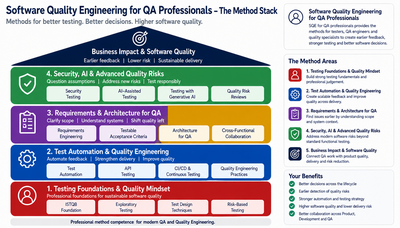
These capabilities form a personal Method Stack for Software Quality.
The Method Stack for Software Testing and Quality Engineering
A Method Stack is not a collection of as many certificates as possible. It describes the methods QA professionals use to investigate requirements, prioritise risks, design suitable checks and communicate quality problems effectively.
Not every person needs the same depth in every discipline. A Test Automation Engineer requires a different focus from a Test Manager. A QA Engineer working on a complex platform needs more architecture knowledge than a tester responsible for an isolated business application.
The right QA training path therefore depends on the role, the system context and the problems that are repeatedly identified too late.
Software Testing Training: The Foundation of Professional QA
Strong Software Testing remains the foundation of the Method Stack. Automation, AI and modern delivery processes change how tests are executed, but not the need for systematic test analysis and design.
Professional testing methods help QA specialists to:
- analyse and prioritise product risks,
- derive test conditions from requirements and system information,
- select appropriate test-design techniques,
- examine boundaries, states and combinations of rules systematically,
- combine static and dynamic testing,
- evaluate test results transparently,
- integrate testing activities into the development process.
ISTQB Training as a Structured Starting Point
An ISTQB training course provides a standardised vocabulary and methodological foundation for Software Testing. The Certified Tester Foundation Level is suitable both for newcomers and for experienced testers who want to structure their knowledge and compare their practice with an internationally established curriculum.
After CTFL, further training should reflect the actual role:
- Test Analyst for business-oriented test analysis and design
- Technical Test Analyst for technical quality attributes and technical testing
- Test Management for strategy, governance and leadership
- Test Automation Engineering for sustainable automation architectures
- Agile Testing for iterative and cross-functional development
- Testing with Generative AI for the controlled use of generative systems in testing
The objective is not to collect certificates in a predetermined order. The next course should close a specific capability gap.
Explore the ISTQB Learning Path
Combining Manual Testing, Exploratory Testing and Test Automation
The question “manual or automated?” often creates a false choice. Both approaches serve different purposes.
Test Automation is particularly valuable for:
- frequently repeated checks,
- rapid regression testing,
- technical interfaces,
- data combinations with high repeatability,
- continuous feedback in CI/CD processes.
Manual and exploratory testing are particularly valuable when:
- a new function is not yet sufficiently understood,
- human judgement is required,
- usability and comprehensibility need to be assessed,
- unusual workflows and interactions are being investigated,
- risks are not yet fully known.
Quality Engineering connects these approaches. The decisive capability is selecting the right testing method for the relevant risk.
Test Automation Training: More Than Learning a Framework
Test Automation training should not focus solely on operating a tool. Sustainable automation requires test design, programming fundamentals, version control, interface knowledge, maintainability and integration with delivery processes.
QA professionals should therefore clarify:
- Which checks provide valuable feedback repeatedly?
- Which tests are sufficiently stable for automation?
- Which data and environments are required?
- How will failed tests be analysed?
- Which automated checks create more maintenance cost than value?
A high number of automated tests is not the same as a credible test strategy.
Requirements Engineering for QA: Finding Defects before Implementation
Many defects do not originate in code. Their causes lie in ambiguous terminology, missing business rules, contradictory expectations or undocumented exceptional cases.
QA professionals with Requirements Engineering competence can intervene earlier. They support product owners, business analysts and domain experts in making requirements understandable and testable.
Requirements Engineering helps QA professionals to:
- identify ambiguity and contradictions,
- recognise missing stakeholders and perspectives,
- challenge business rules and exceptional cases,
- make quality requirements visible,
- supplement user stories with concrete examples,
- formulate verifiable acceptance criteria,
- assess testability during backlog refinement.
An IREB training course can be particularly valuable when QA regularly participates in refinements, specification reviews or business acceptance. QA does not replace Product Management or Business Analysis. Instead, the role gains the capability to raise quality risks before implementation begins.
Explore Requirements Engineering for QA
Software Architecture for QA: Understanding System-Level Risks
A ticket rarely shows every effect of a change. A locally functioning modification can influence other components, data flows, interfaces or system-wide quality attributes.
A basic understanding of Software Architecture helps QA professionals ask stronger questions:
- Which components are directly and indirectly affected?
- Which dependencies will change?
- How does the system behave during failures or delays?
- Which data is exchanged between components?
- What are the consequences for performance, security or maintainability?
- Which integration and system tests are required?
An iSAQB training course can be relevant for QA Engineers, Technical Test Analysts and Test Automation Engineers working with distributed systems, platform architectures, microservices or legacy applications.
QA professionals do not necessarily need the same depth of architecture knowledge as a Software Architect. However, a solid understanding of responsibilities, interfaces, quality attributes and architecture decisions significantly improves risk assessment.
Explore Software Architecture for QA
Secure Engineering and Security Testing for QA Professionals
Functionally correct software can still be insecure. Security problems often appear outside the intended normal workflow:
- manipulated input,
- unauthorised roles or permissions,
- unexpected sequences of calls,
- insecure error handling,
- sensitive information in logs,
- vulnerable dependencies,
- unprotected interfaces.
Secure Engineering and Security Testing competence helps QA professionals recognise when functional testing is insufficient. They learn to challenge security-related requirements, consider misuse scenarios and involve specialised security testing at the right time.
Relevant training topics include:
- OWASP Top 10
- Security Testing Fundamentals
- Secure Development Principles
- Threat Modeling
- API Security
- Identity and Access Management
- Security Champion
- Secure AI and Agentic AI Security
Explore Secure Engineering for QA
AI in Software Testing: Evaluating Results Professionally
Generative AI can support QA in many activities:
- generating test ideas,
- structuring test cases,
- proposing test data,
- creating automation code,
- summarising logs and defects,
- examining requirements for possible gaps,
- preparing technical documentation.
The results still require professional evaluation.
An AI system usually does not know the complete functional and technical context. It may generate obvious test cases while overlooking critical business rules, rare state transitions or organisation-specific risks.
QA professionals therefore need capabilities in two directions:
- They must be able to use AI tools efficiently to support their work.
- They must be able to assess the functional and methodological quality of the generated results.
The faster test artefacts can be produced, the more important test strategy, risk orientation and professional judgement become.
Which QA Training Fits Which Role?
Software Testers and Manual Testers
Operational testers should prioritise strong testing foundations, test design, exploratory testing, defect reporting and Requirements Engineering awareness.
Suitable starting topics include:
- ISTQB CTFL
- Test Analysis
- Exploratory Testing
- Requirements Engineering fundamentals
- Agile Testing
- API Testing fundamentals
Test Automation Engineers
Test Automation Engineers need a strong understanding of test design, automation architecture and delivery processes in addition to tools and programming.
Relevant topics include:
- ISTQB Test Automation Engineering
- API Testing
- CI/CD and Continuous Testing
- Software Architecture fundamentals
- Clean Code for test automation
- Test data and environment management
QA Engineers and Quality Engineers
Quality Engineers work more broadly across the development lifecycle. They connect requirements reviews, testing, automation, risk analysis, architecture and security knowledge.
Relevant topics include:
- Advanced Test Analysis
- Requirements Engineering
- Software Architecture fundamentals
- Secure Engineering
- Quality Engineering practices
- AI-assisted Testing
Test Managers and QA Leads
Test Managers and QA Leads also need strategy, governance, leadership and transformation capabilities.
Relevant topics include:
- ISTQB Test Management
- risk-based test strategy,
- quality metrics and reporting,
- quality gates and governance,
- stakeholder communication,
- development of Quality Engineering organisations.
QA Professionals Working with AI-Based Products
People testing AI systems or AI-generated software need additional competence in data quality, non-deterministic behaviour, security, model risks and regulatory requirements.
The learning path should combine Testing, AI Engineering, Secure AI and, where appropriate, AI Compliance.
Software Quality Engineering for QA Teams
In scaling software organisations, certifying individual testers independently is not sufficient. Teams need a shared target model for how software quality is created throughout delivery.
A coordinated Software Quality Assurance Training programme can help organisations to:
- involve QA earlier in backlog refinement and architecture decisions,
- improve collaboration between product, development and QA,
- distribute quality ownership appropriately,
- coordinate manual and automated testing,
- make test strategy and product risks transparent,
- develop QA roles towards Quality Engineering,
- use generative AI in a controlled manner.
Public seminars are suitable for individual development goals. In-house programmes enable complete QA or development teams to build capabilities around a shared competence model.
From Software Tester to Quality Engineer
Moving towards Quality Engineering does not mean that traditional testing becomes unimportant. Testing remains a central discipline. The role expands through earlier influence and broader responsibility for the system.
Quality Engineers support quality through activities such as:
- reviewing requirements and acceptance criteria,
- conducting risk analyses before implementation,
- supporting testable architecture and observability,
- developing suitable automation strategies,
- integrating quality feedback into CI/CD,
- adding security and resilience perspectives,
- analysing production data and defects,
- continuously improving delivery practices.
The move from tester to Quality Engineer is therefore not a move away from testing. It is an extension of testing competence through adjacent methods.
How to Choose the Right QA Learning Path
The next training step should begin with the problems that are repeatedly discovered too late in daily work.
Useful questions include:
- Are requirements frequently unclear or difficult to test?
- Are defects mainly detected late in the development process?
- Is test automation unstable or expensive to maintain?
- Is there insufficient knowledge of interfaces and system dependencies?
- Are security issues identified only during specialised audits?
- Is responsibility between QA and development unclear?
- Does AI generate large numbers of test artefacts whose quality is difficult to assess?
- Does the QA function lack a transparent career and competence path?
The answers indicate whether the next step should focus on Testing, Test Automation, Requirements Engineering, Software Architecture, Secure Engineering or Quality Engineering.
QA Training at Software Quality Lab Academy
Software Quality Lab Academy offers learning paths and professional training in:
- Software Testing and ISTQB Certified Tester
- Test Analysis and Technical Test Analysis
- Test Management
- Test Automation
- Testing with Generative AI
- Requirements Engineering and IREB CPRE
- Software Architecture and iSAQB CPSA
- Secure Engineering and Security Testing
- AI Engineering and AI Security
Training is available as public seminars, live online courses and dedicated in-house programmes. Organisations can combine several disciplines into a coordinated Method Stack programme for their QA and development teams.
QA professionals do not need complete specialist knowledge in every discipline.
They need sufficient understanding to recognise quality risks early, ask the right questions and involve the right specialists.
Choose Your Personal Training View Upcoming Seminar Dates Discuss an In-House Programme for QA Teams
What does Software Quality Engineering mean for QA professionals?
Software Quality Engineering expands traditional testing through earlier and broader quality activities. QA professionals also contribute to requirements reviews, architecture and security risk analysis, Test Automation and quality feedback throughout delivery. Software Testing remains the methodological foundation.
Is manual testing still relevant despite Test Automation and AI?
Yes. Manual and exploratory testing remain important when investigating new functionality, user behaviour, unknown risks or complex interactions. Automation is particularly effective for stable and repeatable checks; professional QA selects the approach according to the relevant risk and expected feedback value.
Is ISTQB training valuable for experienced QA professionals?
ISTQB training can also be valuable for experienced professionals who want to structure their knowledge, establish a common vocabulary or specialise in Test Analysis, Technical Testing, Test Management or Test Automation. The certificate itself does not replace project experience or professional judgement.
How can I move from Software Tester to Quality Engineer?
The transition involves gradually extending testing competence into Requirements Engineering, Test Automation, Software Architecture, CI/CD, Security and earlier risk management. The right sequence depends on the current role, system environment and recurring quality problems rather than one universal career path.
Which QA training course fits my current role?
Software Testers often begin with CTFL, test-design techniques and exploratory testing. Test Automation Engineers additionally need programming, API Testing, CI/CD and automation architecture, while QA Leads require test strategy, management and governance. Quality Engineers benefit particularly from a combined learning path covering Testing, Requirements Engineering, Software Architecture and Security.